Primafiore Giustiniani was a Genoese slaveholder active in the commercial world of late fifteenth-century Genoa. She was married to the merchant Francesco Gambone. An enslaved baptized Muslim woman named Maria worked in her household and she was liberated by Primafiore in 1497 with a condition of three years of future service. Primafiore retained the right of patronage for the liberated Maria.
The slaveholder, merchant, and citizen of Florence named Bartolo Sonaglini manumits an enslaved woman named Grazia and all her present and future descendants. He also renounces the right of patronage. Grazia is absent during the manumission and is represented by the enacting notary Antonio di ser Chelli.
The slaveholder and nun of the monastery of San Domenico in Pisa named Maria de Caveggia, who was formerly resident in Genoa, manumits an enslaved Circassian woman named Agnese. Maria renounces the right of patronage.
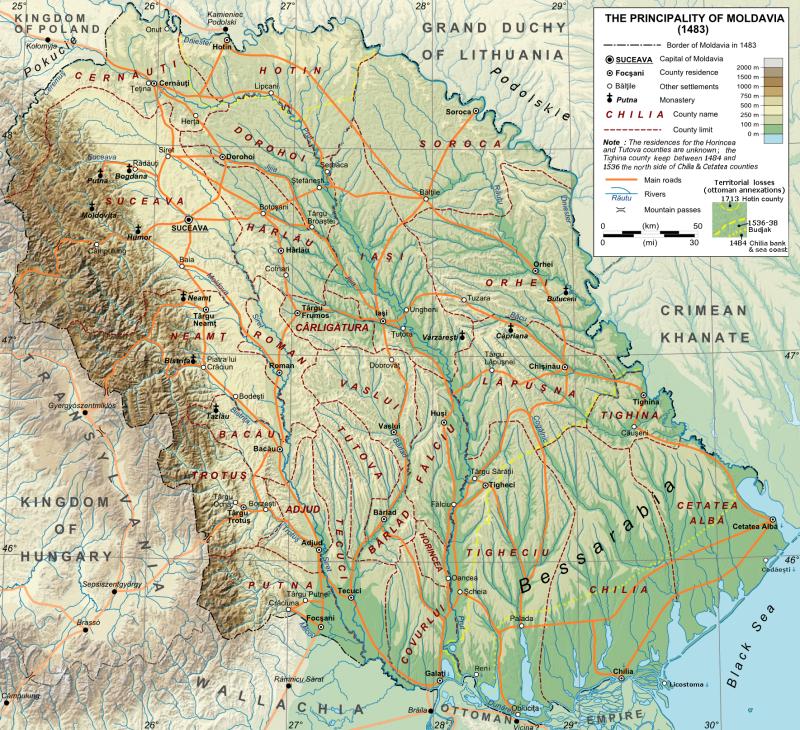
The Principality of Moldavia was a nation situated on the north end of the Black Sea along the Moldovan River, sitated approximately between the Kingdom of Hungary and the Crimean Khanate. It is roughly in the same region as modern-day Moldava.
Prospero Lomellini was active in the early fifteenth century. It appears that he may have died before producing any children, but this is a tentative assertion.
The Casa di San Giorgio was overseen by an extended bureaucracy headed by the Ufficio di San Giorgio. This office consisted of eight executive officers (named protectores) selected by the major shareholders of San Giorgio. The protectores had to be citizens of Genoa and had to hold at least 1000 lire of the communal debt to be eligible to serve in the office. The term of service was generally two years, but was sometimes shorter or longer depending on political conditions. The following individuals served as protectors for the 1410–1412 term.
The Casa di San Giorgio was overseen by an extended bureaucracy headed by the Ufficio di San Giorgio. This office consisted of eight executive officers (named protectores) selected by the major shareholders of San Giorgio. The protectores had to be citizens of Genoa and had to hold at least 1000 lire of the communal debt to be eligible to serve in the office. The term of service was generally one year, but was sometimes shorter or longer depending on political conditions. The following individuals served as protectors for the 1412–1413 term.
The Casa di San Giorgio was overseen by an extended bureaucracy headed by the Ufficio di San Giorgio. This office consisted of eight executive officers (named protectores) selected by the major shareholders of San Giorgio. The protectores had to be citizens of Genoa and had to hold at least 1000 lire of the communal debt to be eligible to serve in the office. The term of service was generally one year, but was sometimes shorter or longer depending on political conditions. The following individuals served as protectors for the 1413–1415 term.
The Casa di San Giorgio was overseen by an extended bureaucracy headed by the Ufficio di San Giorgio. This office consisted of eight executive officers (named protectores) selected by the major shareholders of San Giorgio. The protectores had to be citizens of Genoa and had to hold at least 1000 lire of the communal debt to be eligible to serve in the office. The term of service was generally one year, but was sometimes shorter or longer depending on political conditions. The following individuals served as protectors for the 1416–1417 term.